
Training and your menstrual cycle: what the science really says
Your cycle is a compass, not a curse. How your menstrual cycle affects your training, why rigid phase-based schedules do not hold up, and how to train smarter using tracking and your own signals.
For a long time, training programmes were written as if every week runs the same. For female athletes that is not quite true. Your menstrual cycle affects your energy, your recovery, and sometimes your performance, and ignoring that completely is a missed opportunity.
But a lot of nonsense also does the rounds. So here is an honest overview of training and your menstrual cycle: what your hormones do, what the science really says about it, and how to work with it smartly. The starting point: your cycle is a compass, not a curse.
The four phases and the two hormones
Your cycle begins on day one of your period and runs through four phases: menstruation, the follicular phase, ovulation, and the luteal phase. Two hormones steer the whole thing:
- Oestrogen rises through the follicular phase and peaks just before ovulation. It is linked to a building (anabolic) signal and to more available energy during prolonged effort.
- Progesterone rises in the luteal phase, raises your body temperature a fraction, and affects your heat regulation.
Important to flag straight away: the "normal" cycle length varies widely, roughly from 25 to 40 days. Schedules that say "do this on day 14" therefore simply do not apply to many women.
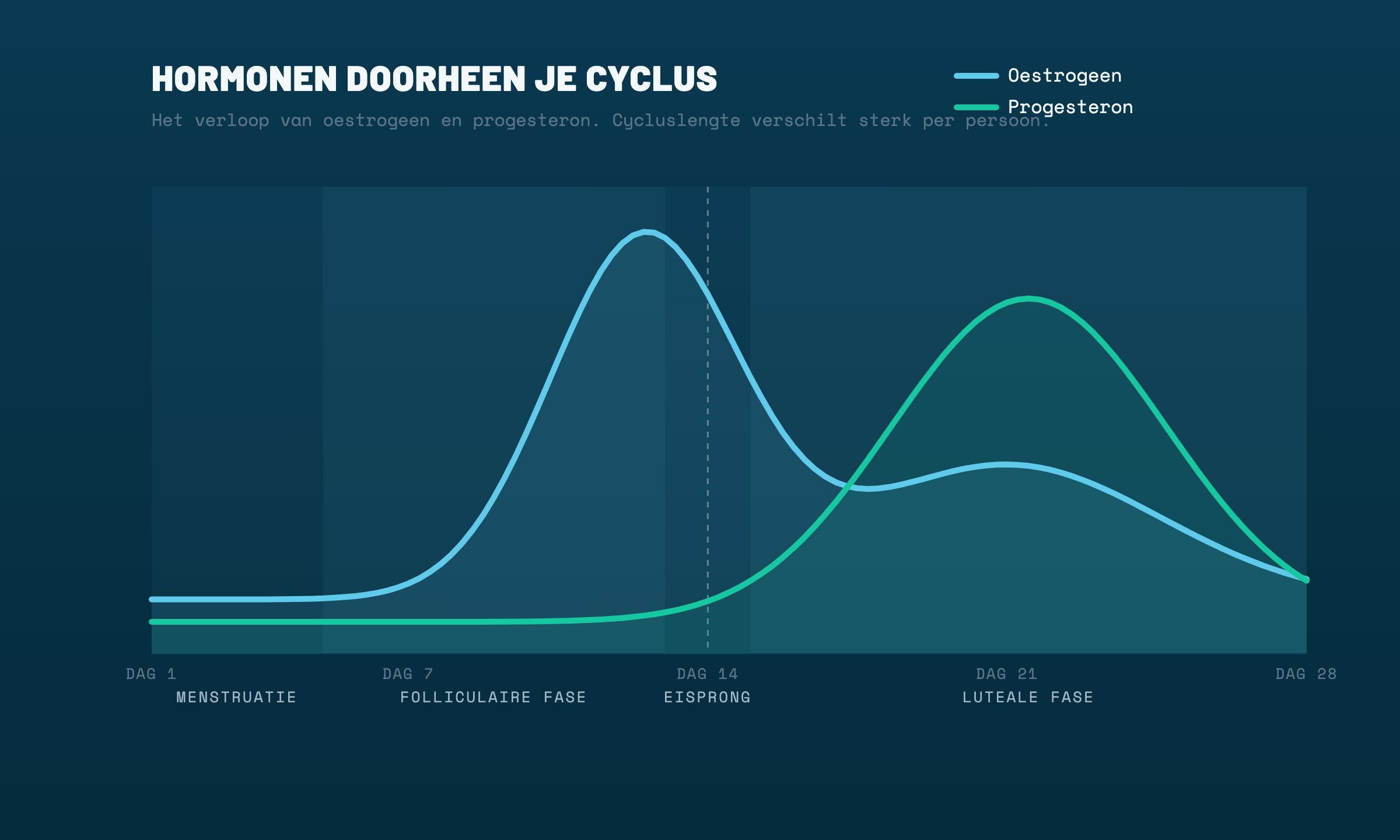 The hormonal course in an average cycle. Phase lengths vary greatly from person to person, so treat it as a guideline, not a calendar.
The honest science: no rigid rulebook
You read it everywhere: train hard in the follicular phase, take it easy in the luteal phase. It sounds logical. But it does not hold up when you look at the best research.
A large systematic review (McNulty and colleagues, 2020) concluded that your performance in the early follicular phase may be very slightly lower, but that the effect is so small, the studies so inconsistent, and the quality of evidence so low, that no general guideline can be drawn from it. The authors' own recommendation: a personalised approach. More recent research that looked only at the methodologically rigorous studies reached the same conclusion: no consistent, reliable effect of cycle phase on performance.
In other words: the differences between women are larger than the average phase effect. So a fixed schedule that applies to everyone does not exist. That is no reason to ignore your cycle, but it is a reason to stop with rigid rules and start listening to your own body.
Not training less, but planning smarter
Cycle-based training is not about scaling down. It is about planning your hard and easy blocks around how your body feels and recovers at that moment.
In practice that means, for example:
- Shifting a key session if you consistently feel rough in a particular phase, and pushing on in the phases where you feel strong.
- Accounting for the slight temperature rise in the luteal phase, which can make hot sessions feel harder.
- Taking symptoms like sleep, energy, and heaviness seriously as training data, not as an excuse.
It is not a brake on your ambition. It is a way to support your ambition even better.
Why tracking is the key
Because the differences are so individual, smart training does not start with a prescription, but with observing. Track how you feel and perform over a few cycles. Patterns that repeat themselves are valuable information for your planning.
What is best to track:
- Your cycle length and the pattern of your period
- Your energy and motivation
- Your perceived strength and how hard sessions feel at the same load
- Your sleep quality
- Symptoms like cramps, bloating, tender breasts
After a few cycles you often see recurring signals: a phase where you feel strong, a phase where everything feels a bit heavier. That is what you tune your schedule to, to your pattern, not to a general theory.
Training on the pill
If you use hormonal contraception, things are different. The pill suppresses your own oestrogen and progesterone and replaces them with a constant dose, which flattens the natural fluctuations. The withdrawal bleed you then get is not the same as a natural period.
In practice that means: phase-based training largely does not apply, because the cyclical pattern it relies on is barely there. The principle still holds, though: match your load to how you feel and recover. Research shows, by the way, no clear advantage or disadvantage of the pill for strength and performance development. So there is no reason to start or stop the pill for the sake of your sport; that is a personal choice.
Exercising during your period
Let us clear up one misconception straight away: you can absolutely exercise during your period. In fact, moving can ease your cramps through better circulation and the release of endorphins, and it does your mood good.
The approach is simple: on good days you simply keep training, on hard days you choose lighter or shorter sessions and focus on gentle movement, sleep, and recovery. Do not force a hard key session if your symptoms are high. Adjust to how you feel, not to the calendar.
Your cycle as a health signal
Finally, the part that is too often left unsaid. A regular cycle is a sign of a good energy balance and health, not only of fertility. That makes it a useful training signal too.
When your intake consistently fails to match what your training demands, that is called low energy availability. If it persists, it leads to RED-S (relative energy deficiency in sport): disrupted hormones, worse bone health, slower recovery, more injuries, and poorer performance.
So: a missing period is a red flag, not an achievement. If your period stops or becomes irregular, treat that as information that your body may be getting too little fuel for your training load. Eat more, reduce your load, and seek guidance. This is exactly where a good coach and a sports dietitian together make the difference.
Listening is a skill
Training matched to your cycle is ultimately a form of listening well to your body, and matching your planning to it. No rigid schedule, no guilt, but an extra layer that lets you train more precisely.
At HYTX this is a fixed part of our approach for female athletes: we match the training load to your cycle and your own signals, so it fits what your body can handle at that moment. That fits into our broader philosophy of a schedule built around you, not around an average. You see it back in all our coaching in Antwerp, from running to triathlon. Your cycle is a compass. Learn to read it, and it points you forward.
FAQ